Louisiana and New Orleans
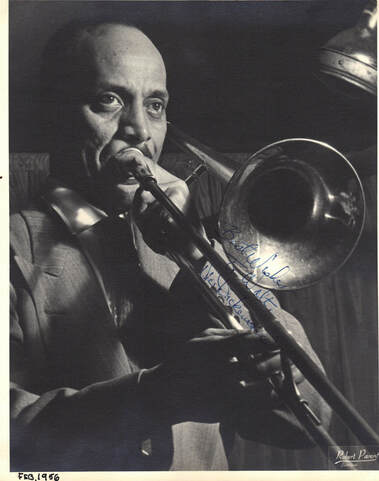
Ory was born on Christmas Day 1886 on the Woodland Plantation near LaPlace, Louisiana, and as a boy played homemade instruments before taking up the trombone. By his teens he was leading a well-regarded band in southeastern Louisiana, and he later brought it to New Orleans, where it became one of the leading bands in the city. Over the years he employed many of the musicians who would define early jazz: Joe “King” Oliver, Johnny Dodds, Jimmie Noone and, from 1919, a young Louis Armstrong.
California and Chicago
Ory moved to Los Angeles in 1919, and there in 1922 he recorded “Ory’s Creole Trombone” and “Society Blues,” among the first jazz recordings made on the West Coast by a Black New Orleans band, selling the discs under his own label as Kid Ory’s Sunshine Orchestra. From 1925 he worked in Chicago, recording with Armstrong, Jelly Roll Morton, Oliver, Dodds, Bessie Smith and Ma Rainey. He was a member of Armstrong’s original Hot Five, and in February 1926 the group recorded his “Muskrat Ramble,” which became one of the most-played tunes in traditional jazz.
The tailgate style and the revival
Ory is credited with the “tailgate” style of New Orleans trombone, a rhythmic, harmonically supportive part built on bold slides beneath the trumpet and clarinet, and with making the glissando central to the music. He left music during the Depression and ran a chicken farm in Los Angeles, but returned in 1943–44, when the revival of New Orleans jazz made his band one of the most celebrated of its kind, heard weekly on The Orson Welles Almanac from March 1944. He ran the Tin Angel nightclub in San Francisco from 1958 to 1961, retired in 1966, and spent his last years in Hawaii, where he died on January 23, 1973.